
On this page23 sections
Choosing the Right System for Your West Michigan Property
When someone calls High Caliber Concrete Coatings, one of the first questions we ask is simple: “Is this a home or a commercial facility?”
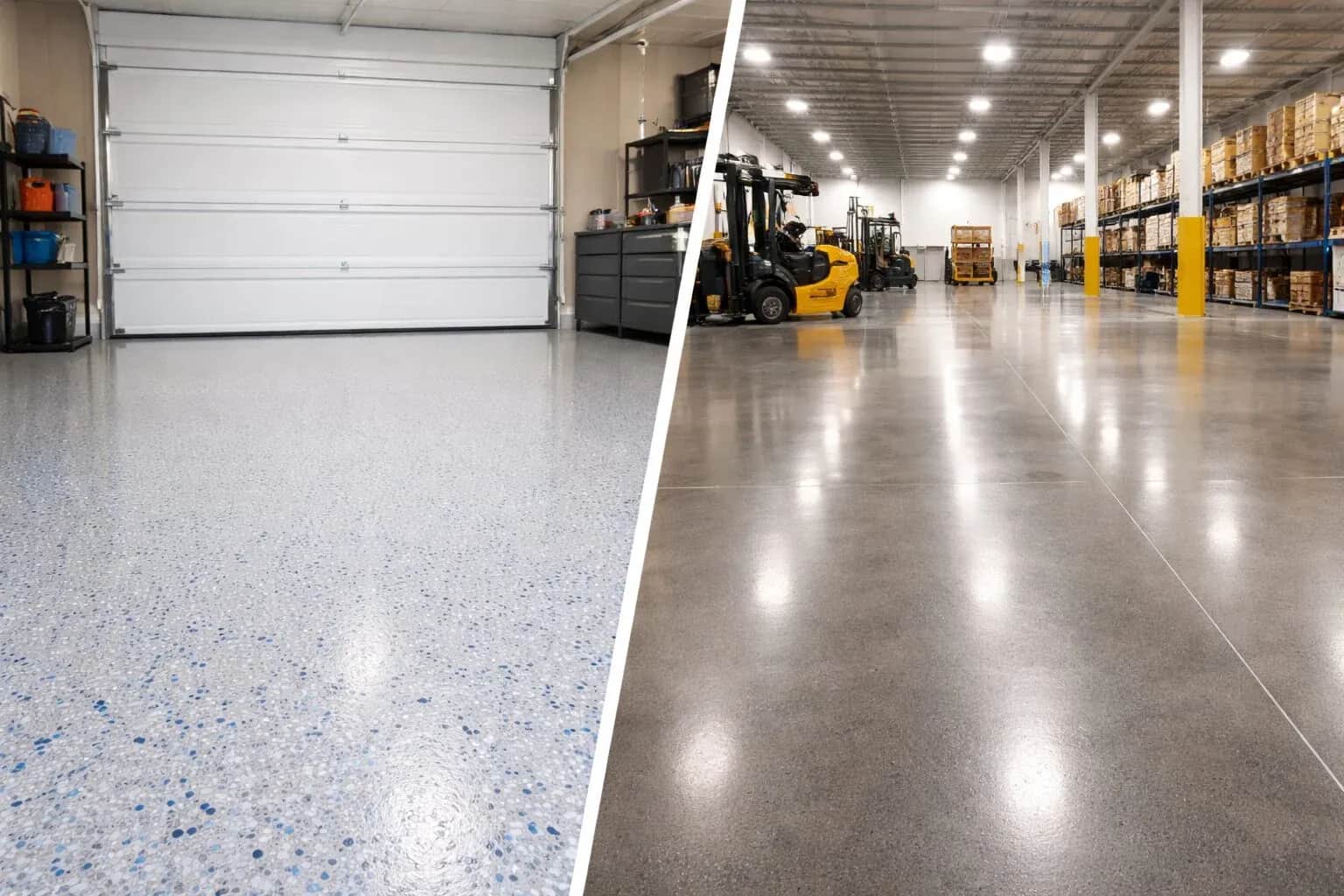
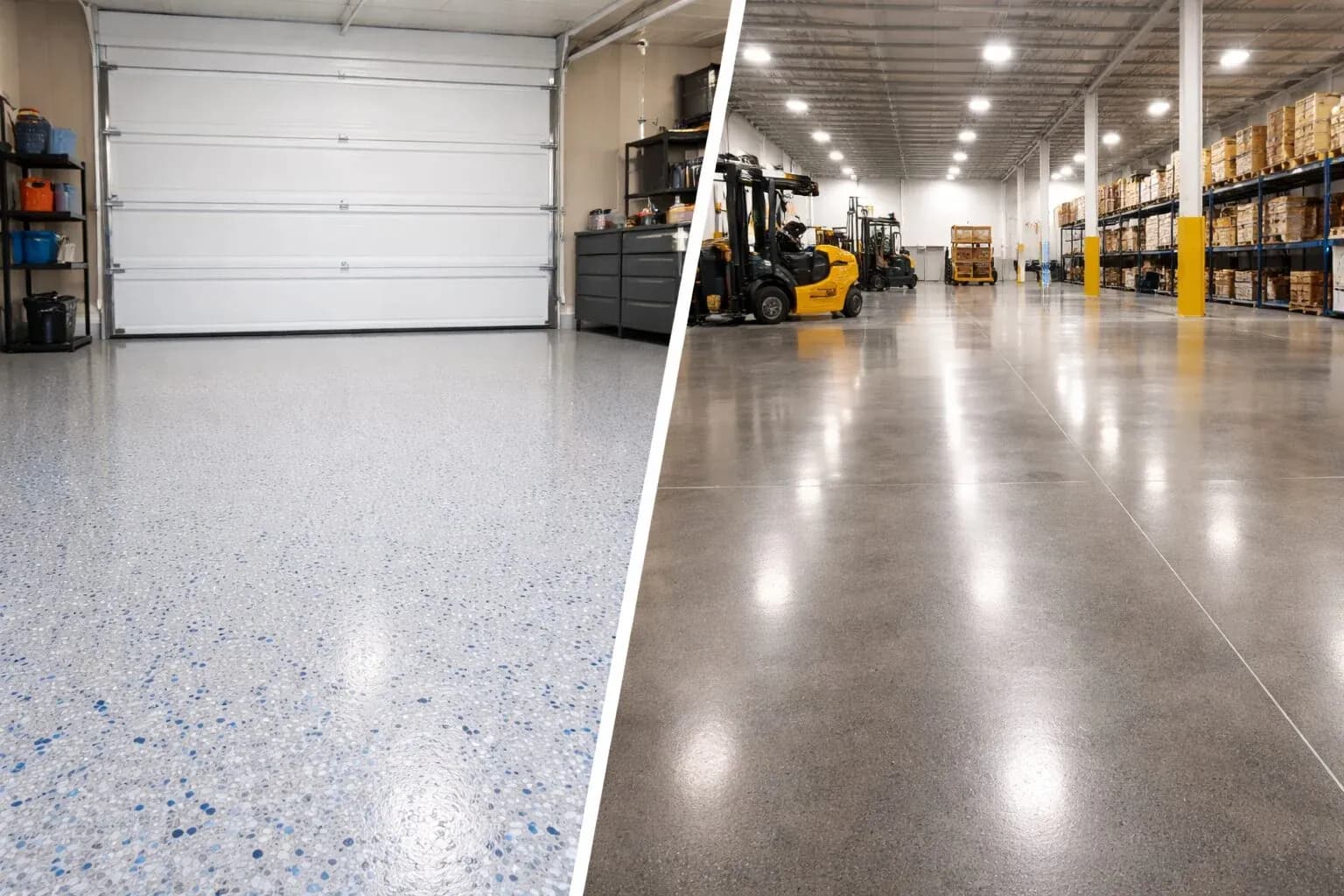
At first glance, concrete is concrete. But once you begin comparing commercial vs residential floor coatings, the differences become clear very quickly. The way a space is used, the weight it supports, the chemicals it sees, and even how quickly it needs to return to service all shape the type of system that should be installed.
In West Michigan, we install coatings in everything from home garages and basements to auto shops, warehouses, and retail spaces. Each environment demands something different. Understanding those differences helps property owners make confident, long term decisions.
Let’s break it down.
1. Differences in Usage and Traffic Demands
The most obvious distinction in commercial vs residential floor coatings comes down to how the floor is used every single day.
Residential Usage
In a typical West Michigan home, coated concrete surfaces are found in:
- Garages with passenger vehicles
- Basements used for recreation or storage
- Basements exposed to moisture
- Pole barns with light equipment
Residential floors see predictable traffic. A vehicle enters and exits. Kids ride bikes. Snow and road salt get tracked indoors during winter. There is wear, but it is intermittent and manageable.
Homeowners want a floor that looks sharp, cleans easily, and holds up to normal family life. That balance of durability and aesthetics is why flake systems with polyurea or polyaspartic topcoats are so popular.
Commercial and Industrial Usage
Commercial floors operate under entirely different stress levels. These spaces often include:
- Auto shops and service bays
- Warehouses with forklifts
- Manufacturing facilities
- Retail environments with continuous foot traffic
Instead of one vehicle parking overnight, commercial floors may experience nonstop movement, heavy equipment, fluid spills, and repeated turning forces that grind against the surface.
When comparing industrial flooring vs garage coatings, traffic intensity is the most dramatic difference. A forklift pivoting on a warehouse slab places far more stress on a coating than a family SUV ever will. That is why commercial systems are engineered for heavier, more consistent loads.
2. Material Thickness and Performance Requirements
Usage drives performance requirements. Performance requirements drive system design.
Residential System Requirements
For residential installations, performance priorities typically include:
- Resistance to road salt and moisture
- Protection from hot tire pickup
- Impact resistance from dropped tools
- UV stability for sun exposed areas
These systems are built to protect the slab while maintaining an attractive finish. Mechanical preparation through professional concrete grinding is critical to ensure proper adhesion and long term performance.
Many homeowners researching coatings start by understanding what a concrete coating is and how the system bonds to the slab. Once that foundation is clear, the focus shifts to choosing between epoxy, polyurea, or hybrid systems.
Commercial and Industrial System Requirements
Commercial systems must account for:
- Higher load bearing capacity
- Greater abrasion resistance
- Chemical exposure tolerance
- Thermal shock in some environments
For example, an auto service bay may need enhanced resistance to petroleum products and brake fluid. A warehouse may require thicker build systems that handle forklift traffic without premature wear.
Material selection becomes more technical in commercial settings. Cure time, flexibility, adhesion, and chemical resistance all help determine the right layer for each job. Rather than forcing an either-or choice, a carefully designed hybrid coating system can provide the right balance.
The bottom line is simple. Residential systems are engineered for lifestyle durability. Commercial systems are engineered for operational durability.
3. Installation Logistics and Scheduling
Installation is another major difference between commercial vs residential floor coatings.
Residential Installation Considerations
Home installations are typically straightforward:
- The space is cleared
- The slab is mechanically ground
- The coating system is installed
- The space returns to service quickly
Many of our West Michigan residential projects are completed within one to two days, depending on square footage and environmental conditions. Fast curing polyurea coatings are especially attractive because homeowners can get back to using their garage quickly.
Commercial Installation Considerations
Commercial projects require more coordination. Consider the variables:
- Can operations shut down completely?
- Does installation need to be phased?
- Are nights or weekends required?
- Are there temperature controls in place?
A warehouse cannot always afford several days of downtime. An auto shop may need to keep at least one service bay operational. Retail spaces must plan around customer traffic.
Commercial installations involve careful scheduling, safety planning, and communication with facility managers. The coating system must not only perform well, it must also be installed in a way that minimizes operational disruption.
4. Maintenance and Cleaning Expectations
Maintenance standards often reveal the clearest difference between industrial flooring vs garage coatings.
Residential Maintenance Expectations
Homeowners typically prioritize:
- Easy sweeping and mopping
- Resistance to staining from oil or salt
- A surface that stays clean with minimal effort
A properly installed flake system creates a seamless surface that prevents contaminants from penetrating the slab. That is one reason many homeowners discover that the benefits of a garage floor coating go far beyond appearance.
Commercial Maintenance Expectations
Commercial facilities often require:
- Frequent machine scrubbing
- Strict sanitation standards
- Slip resistant surfaces for employee safety
- Long term resistance to chemical cleaning agents
An auto shop floor may be cleaned daily. A warehouse may use industrial scrubbers regularly. Restaurants and food processing environments may have sanitation regulations that require seamless, non porous surfaces.
These environments demand coatings that can handle aggressive cleaning without degrading. Durability under maintenance pressure is just as important as durability under traffic pressure.
5. Cost and Budget Considerations
Cost conversations differ significantly between residential and commercial clients.
Residential Budget Perspective
For homeowners, a coating is often viewed as:
- A home improvement investment
- A way to increase property appeal
- A long term protection solution
Pricing is usually calculated per square foot, and aesthetics play a meaningful role in the decision. While budget matters, most homeowners understand that professional installation prevents future slab repairs.
Commercial Budget Perspective
Commercial budgeting focuses on long term value and operational impact. Facility managers consider:
- Downtime costs
- Repair frequency
- Liability exposure
- Lifecycle durability
In commercial environments, the cheapest upfront option is rarely the smartest long term decision. A failed coating interrupts business and creates additional expense.
When evaluating commercial vs residential floor coatings, commercial clients often prioritize performance and longevity over decorative features.
6. Safety, Compliance, and Regulatory Needs
Safety requirements become more complex in commercial settings.
Residential Safety Priorities
Residential safety usually centers on:
- Slip resistance during wet conditions
- Protection against moisture intrusion
- Reducing surface deterioration
In West Michigan winters, snow and road salt make slip resistance important in garages and entry areas.
Commercial and Industrial Safety Requirements
Commercial facilities may need to meet:
- OSHA slip resistance standards
- Chemical containment guidelines
- Fire safety regulations
- Industry specific compliance requirements
Auto shops and service bays, for example, must consider chemical exposure and employee safety. That is why businesses researching coatings often review systems recommended for auto shops and service bays before moving forward.
Commercial floors carry greater liability risk. The coating system must support safety, not just appearance.
7. Choosing the Right System for Each Environment
There is no universal answer when it comes to coatings. The right solution depends on how the space functions.
Residential properties benefit from systems that balance durability, moisture resistance, and visual appeal. Commercial facilities require coatings that prioritize structural performance, chemical resistance, and operational continuity.
At High Caliber Concrete Coatings, every project begins with an evaluation of the slab condition, moisture levels, traffic expectations, and long term goals. Surface preparation, including professional concrete grinding, lays the foundation for performance. From there, the appropriate epoxy, polyurea, or hybrid system is selected based on real world use.
Being locally owned and serving West Michigan means understanding how freeze thaw cycles, road salt, and humidity impact concrete year after year. That regional knowledge matters.
Side by Side Comparison: Commercial vs Residential Floor Coatings
- Category: Traffic Load; Residential Floor Coatings: Passenger vehicles and light foot traffic; Commercial Floor Coatings: Forklifts, heavy equipment, constant traffic
- Category: System Thickness; Residential Floor Coatings: Moderate build for durability and aesthetics; Commercial Floor Coatings: Heavier build for structural performance
- Category: Chemical Exposure; Residential Floor Coatings: Occasional oil and salt; Commercial Floor Coatings: Frequent petroleum, industrial chemicals
- Category: Installation Timeline; Residential Floor Coatings: 1 to 2 days typical; Commercial Floor Coatings: Phased scheduling often required
- Category: Maintenance; Residential Floor Coatings: Light cleaning, occasional mopping; Commercial Floor Coatings: Frequent machine scrubbing and sanitation
- Category: Safety Requirements; Residential Floor Coatings: Slip resistance for home use; Commercial Floor Coatings: OSHA and industry compliance standards
- Category: Budget Focus; Residential Floor Coatings: Home improvement investment; Commercial Floor Coatings: Long term operational ROI
Final Thoughts on Commercial vs Residential Floor Coatings
The difference between commercial vs residential floor coatings is not just about size. It is about performance expectations, traffic intensity, chemical exposure, safety requirements, and long term operational goals.
A residential garage coating is designed to protect and enhance a home. A commercial floor coating is engineered to support business operations.
If you are evaluating options for your home, warehouse, auto shop, or retail facility in West Michigan, the best first step is a professional assessment. High Caliber Concrete Coatings provides customized system recommendations built around your environment and usage demands.
Schedule your consultation to discuss your project or request a quote. Whether you need a high performance garage floor or a commercial grade coating system, High Caliber Concrete Coatings delivers durable solutions designed for Michigan conditions.